
AI and Physics: A New Roadmap for Rare-Earth-Free Magnets
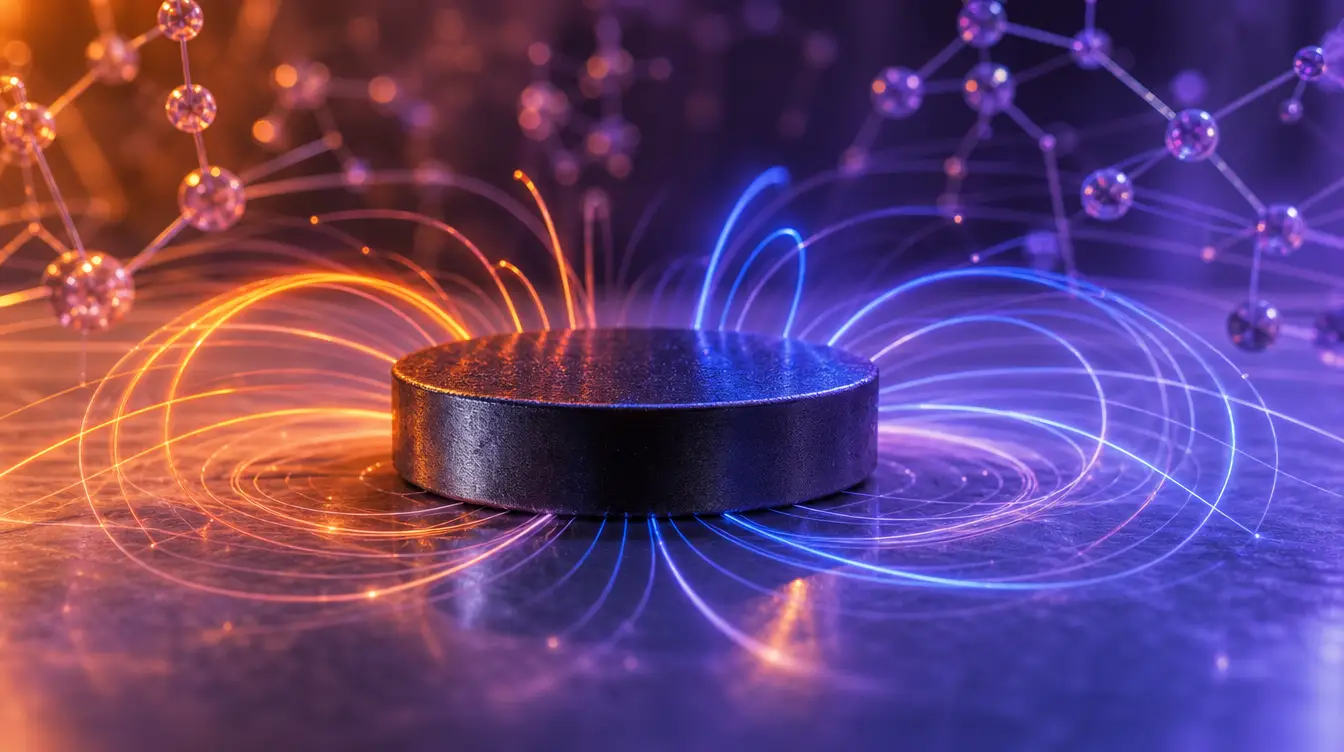
A team at Ames National Laboratory, part of the U.S. Department of Energy, has presented a roadmap that combines physics and artificial intelligence to design permanent magnets without rare earths. Below we review what the method involves and why it could change how the key components of electric technology are made.
From trial and error to guided design
The work, led by scientist Prashant Singh, proposes predicting how a material will behave before it is ever built in the lab. To do so, the team integrates physics-based modeling, high-throughput computational simulations, and AI tools capable of reasoning over the data. The goal is to replace the slow, costly trial-and-error search with a more systematic process, in which the algorithm flags the most promising candidates and rules out those that will not work. The research was published on June 3, 2026, in the journal Advanced Functional Materials.
Why rare-earth-free magnets matter
The most powerful magnets made today rely on so-called rare earths, a group of elements that are expensive and tied to fragile supply chains, often concentrated in just a few countries. These magnets are essential parts in electric vehicle motors, wind turbines, power generation equipment, and defense applications. Finding alternatives that are just as effective but free of those critical elements would cut costs and reduce dependence on external suppliers. Singh sums up the challenge with a simple idea: to design a material, you need to understand how its performance changes when you combine two elements.
A methodology, not a finished magnet
One point that is often misunderstood is worth clarifying: the study does not announce the discovery of a new, production-ready magnet, but rather a methodology that speeds up that search. The team itself builds on earlier developments such as DuctGPT, an agent-type AI designed for interactive materials design. The work is part of the Department of Energy’s Genesis Mission, an initiative that brings together national laboratories, industry, and universities to apply artificial intelligence to scientific discovery, including securing the supply of critical minerals.
Where materials science is heading
Beyond this specific case, the approach illustrates a growing trend: using AI not to replace the researcher, but to guide their decisions and shorten years of experimentation. If the method proves reliable, it could be applied to other materials problems in energy, electronics, and mobility.
At Webmusica we build web solutions with cutting-edge tech. Let’s talk about your project.
Source: Ames National Laboratory.


 «Naturaleza viva» – El colibrí.