
Atlas Gets a New Hand: Boston Dynamics Trades Human Looks for Toughness
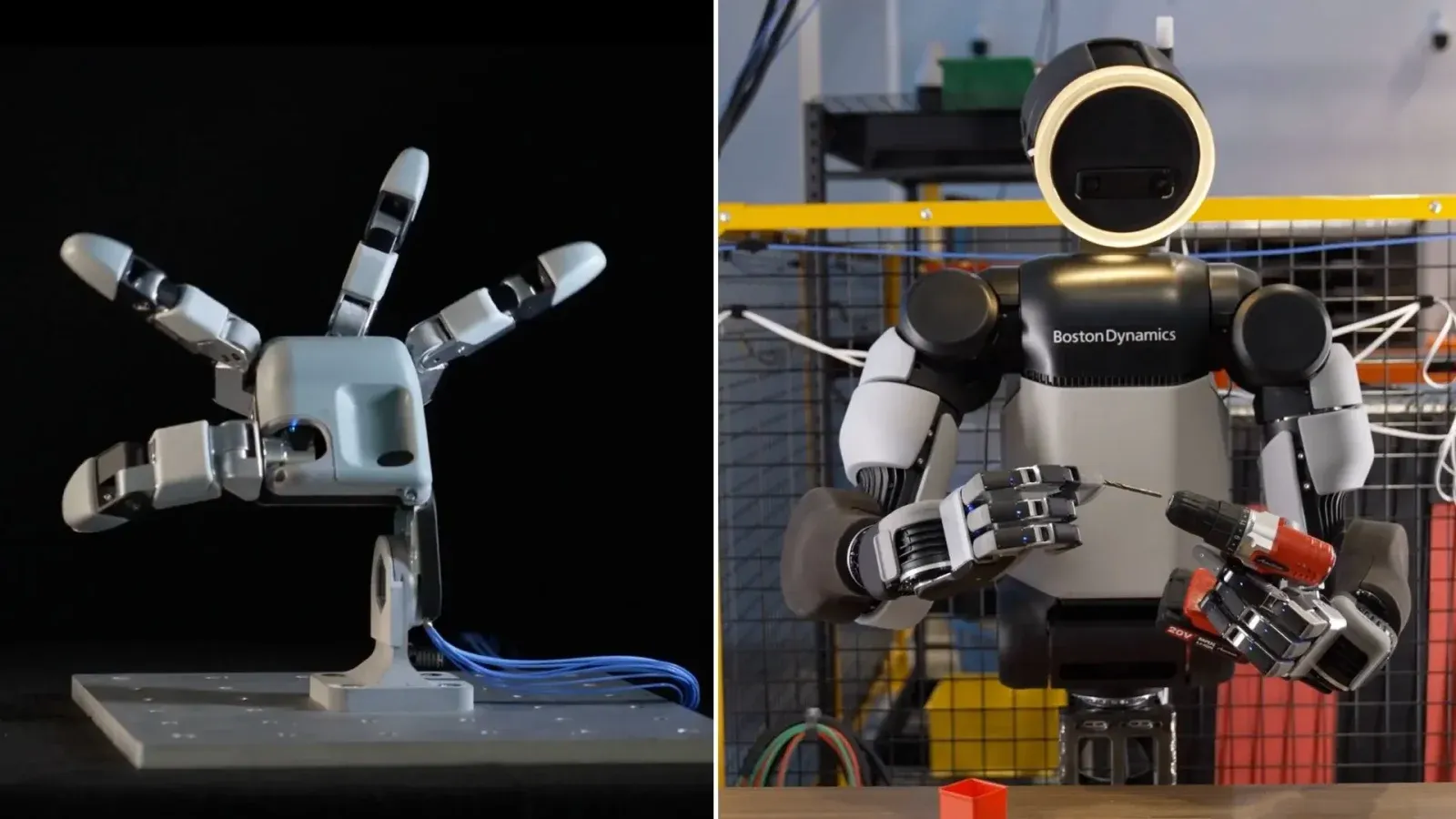
Thirteen degrees of freedom, three fingers and a thumb: that is the new hand Boston Dynamics has unveiled for its Atlas humanoid robot. Here is what changed and why the company decided that looking human was not the priority.
Fewer Fingers, More Motion
The previous design offered just 7 degrees of freedom. The new version nearly doubles that to 13 and drops the pinky to focus on what matters. The fingers can also splay open so that one moves against another, letting the hand hold the trigger of a tool such as a drill or a welding torch.
Actuators Inside the Joints
The key is in the mechanics. Actuators are built into each joint with a direct-drive setup that lets the motors be back-driven and react to force and contact. No tendons or cables run across the joints, so there is less to stretch or snap. Each actuator pack can be swapped as a single unit, which keeps repairs cheap.
Designed to Be Built at Scale
The team is aiming for reliability, ease of manufacturing and cleaner simulation. According to Alberto Rodriguez, director of robot behavior at Boston Dynamics, hands are a ruthless design trade-off. He also said the team is working out how to produce 100,000 of these hands a year, a figure that shows the project’s industrial ambitions. The report does not give specific force or durability numbers, though.
Learning From Human Demonstrations
There is an interesting detail: although the design does not try to imitate how a human hand looks, it keeps a size and shape close enough that demonstrations performed by people can be used to train the robot. It is a practical balance. The hand does not need to be pretty, but it should learn from the way we work, while also withstanding impacts, loads and continuous use without becoming a maintenance headache.
Why It Matters
The hand is often one of the most delicate parts of any humanoid robot: it is complex, fragile and expensive to repair. When a company of this weight puts robustness and cheap repairs ahead of looks, it shows where the industry is heading, away from flashy demos and toward tools that can last a full shift on a factory floor.
IEEE Spectrum’s Evan Ackerman admits the hand looks less elegant than those of other humanoids, but argues its toughness may be what gets it into real factories first.
At Webmusica we build web solutions with cutting-edge tech. Let’s talk about your project.
Source: IEEE Spectrum.


 «Naturaleza viva» – El colibrí.