
Humanoid Robots Run the 100 Meters Faster Than Usain Bolt at the Beijing Games
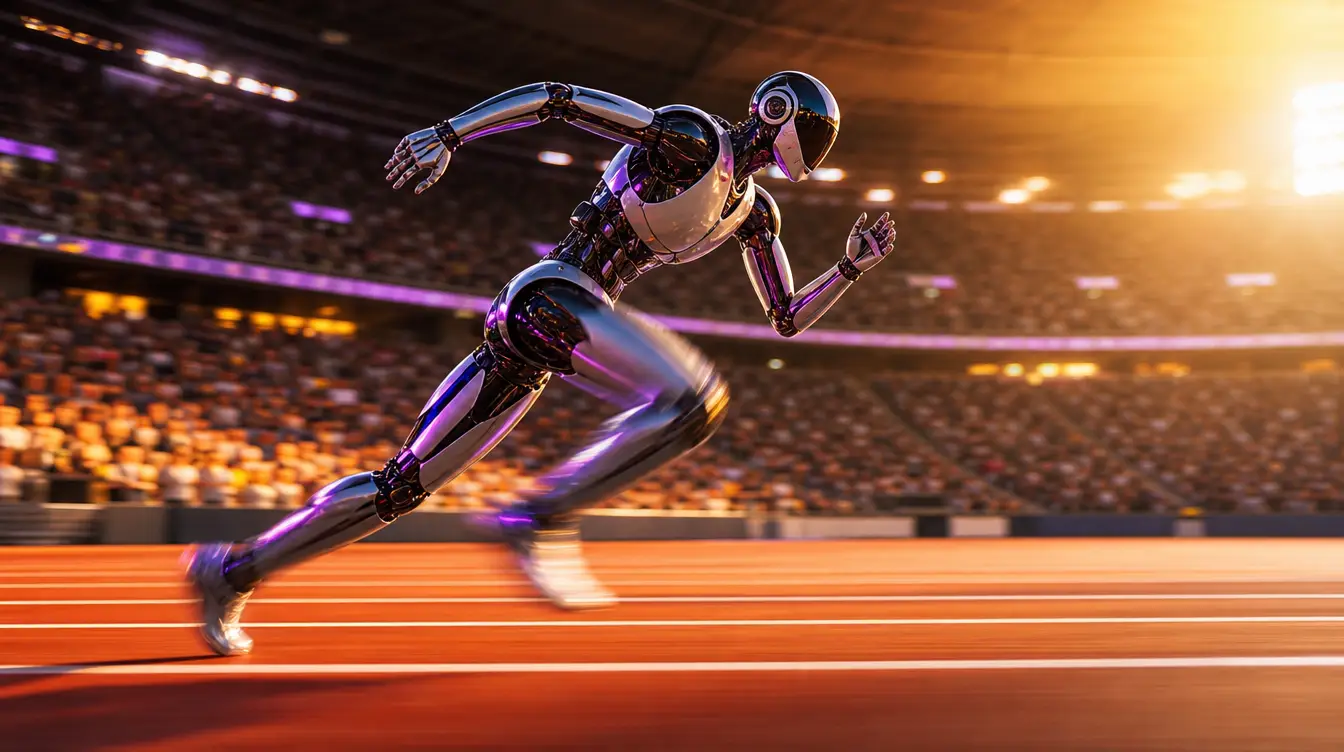
At the second edition of the World Humanoid Robot Games, held in Beijing and wrapping up on Wednesday, August 26, 2026, a bipedal robot called Tiangong Ultra covered 100 meters in 8.64 seconds, nearly a full second under the human record. We look at what happened on the track, who builds these machines and why experts urge looking beyond the stopwatch.
Three records in four days
Tiangong Ultra lowered its own mark in succession: 9.39 seconds on opening day, 8.86 on Tuesday and 8.64 on Wednesday. For context, the men»’s world record in the 100-meter dash is 9.58 seconds, standing since 2009. The comparison has limits, since robots do not start from blocks or cover the distance with an athlete»’s mechanics, but the progression over a few days shows how quickly bipedal locomotion control is advancing. The same event logged other benchmark times for the category, such as 38.15 seconds in the 400 meters, 2:21.64 in the 1,500 meters and 2.88 meters in the high jump.
Who is behind Tiangong
The robot was developed by the Beijing Humanoid Robot Innovation Center, also known as X-Humanoid, a center founded in 2023 whose shareholders combine state-owned firms with the robotics units of Baidu and Xiaomi. The event brought together more than 2,000 robots from 666 teams across 51 events that went well beyond track and field: there was soccer, boxing, dancing and real-task challenges such as housework, hotel service and emergency response. Not everything went smoothly: several machines slammed into the mat placed past the finish line, sparks flew, staff used fire extinguishers and some robots were carried off on stretchers. One came apart mid-race.
The stopwatch is not the metric that matters
Jonathan Hurst, a robotics professor at Oregon State University, argued that real progress will be measured in warehouses and factories, where humanoids work autonomously and generate verifiable economic value, not in track times. It is a view widely shared across the industry: sporting exhibitions are useful for testing balance, power and recovery from falls, but the commercial goal is repetitive tasks in logistics and industrial settings. Even so, watching a robot cross a finish line at that speed helps show how much ground has been covered in just a few years.
At Webmusica we build web solutions with cutting-edge tech. Let»’s talk about your project.
Source: OPB / Associated Press.


 «Naturaleza viva» – El colibrí.